Why We Ask Questions Instead of Giving Clients Scripts
We usually skip the word for word script and start with questions instead. It helps people sound more natural on camera, takes some of the pressure off, and often gives us enough material to create multiple pieces of content from one conversation.
A lot of business owners assume being on camera means memorizing lines, reading from a teleprompter, or trying to sound polished enough to get through a script without messing up.
That’s usually not how we like to work.
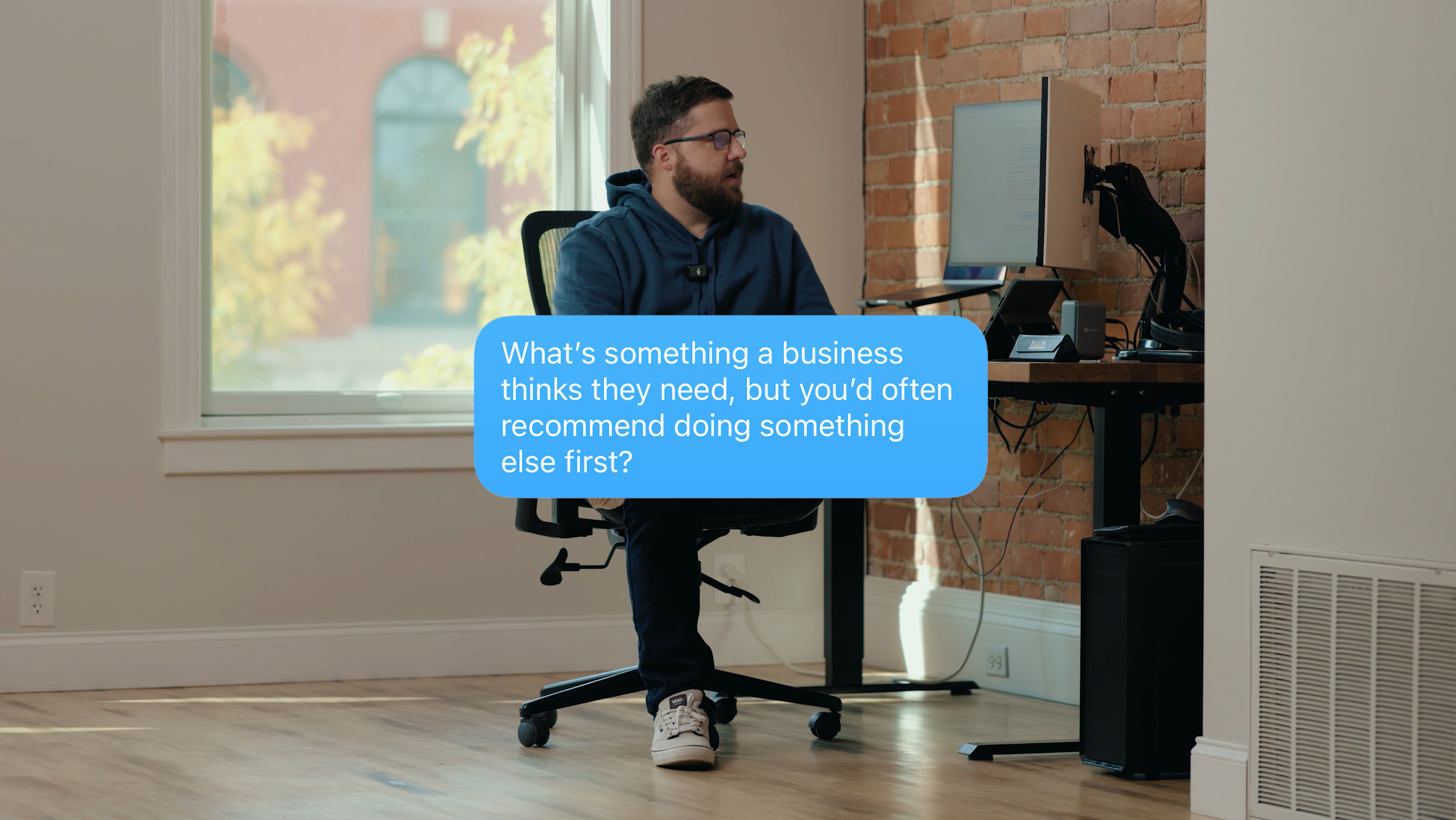
For a lot of the content we create, we’d rather ask questions and have an actual conversation.
It takes some of the pressure off, it usually sounds more natural, and it gives us better material to work with.
Most people don’t need to become “good on camera”
A lot of people are perfectly comfortable talking about their business until a camera turns on.
Then everything changes.
They start worrying about where to look, whether they’re saying the right thing, whether they sound professional enough, and whether they’re going to forget the next sentence.
That’s usually when scripted content starts sounding scripted.
The goal isn’t to turn somebody into an actor.
It’s to get them talking about something they already know.
Their business.
Their customers.
The questions they get all the time.
The problems they solve.
Once the conversation starts moving, the camera usually becomes a lot less important.
Questions usually sound more like the actual person
There’s nothing wrong with scripts.
Sometimes they make sense, especially when something needs to be very specific or carefully worded.
But for a lot of short-form business content, we’d rather start with a question.
Instead of:
“Read this paragraph exactly the way we wrote it.”
It might be:
“What’s one mistake you see customers make all the time?”
Or:
“What do people usually misunderstand about this service?”
Or:
“What should someone know before hiring a company like yours?”
Those questions usually get a much better answer because the person isn’t trying to remember lines.
They’re just explaining something they already understand.
One question can turn into more than one video
This is another reason we like this approach.
Sometimes somebody answers one question and gives us three different ideas without even realizing it.
Maybe the first part of the answer explains the problem.
The second part gives advice.
The third part tells a story about something that happened with a customer.
Those can potentially become three separate pieces of content.
That’s a lot more useful than spending all of your production time trying to get one perfect take of one perfectly written script.
It also makes production days easier
A production day doesn’t need to feel like a commercial shoot every time.
We can show up with a list of questions, talk through them, follow the interesting answers, and build content from the conversation.
That gives us structure without making everything rigid.
It also gives the client room to actually sound like themselves.
That matters.
Because if someone talks one way in real life and suddenly sounds completely different in every video, people notice.
Scripts still have their place
There are definitely situations where we’ll use scripts.
Ads with very specific messaging.
Videos where certain details need to be included.
Announcements.
Legal or technical information where wording matters.
But even then, sometimes the best move is to use a loose outline instead of a word for word script.
The goal is still the same.
Make the person sound clear, confident, and like themselves.
Good business content usually starts with a good conversation
You don’t need to memorize a page of copy to make useful video content.
You need good questions.
You need somebody who understands what you do.
And you need a process that can turn a real conversation into something worth posting.
That’s usually where we start.
Because the best content often doesn’t come from reading the perfect script.
It comes from getting somebody talking about something they actually know.